
BGM4NW
Department of Occupational, Social and Preventive Medicine
The world of work is undergoing profound change as a result of digitalisation, demographic change and cross-sector networking. This has been exacerbated by the massive restructuring within companies in a very short period of time during the COVID-19 pandemic.
New Work and the strengthening of health measures
Digital, flexible and agile forms of work (New Work) can pose health challenges for employees. Sustained strengthening of prevention in these forms of work is therefore of great importance.
Exploring potentials and risks with partners
As part of the project, researchers will now work with digitalisation specialists, statutory health insurance providers and representatives from the fields of occupational health and safety, workplace health promotion, human resources and integration management, and organisational and corporate structure to analyse the health-promoting potential and risk factors of new forms of work.
Development of occupational health management programmes and prevention strategies
Together with employees in New Work structures, decision-makers from various companies and other experts, tailor-made offerings for occupational health management (OHM) in the New Work context are being developed. Obstacles and motivators in the use of such offerings are being reflected upon, and immediate implementation in the participating companies is being sought. The aim is to strengthen prevention in the context of New Work and to maintain and promote the health of employees in the long term.
Multidimensional working definition of new work settings
Approach and differentiation into four areas
As part of the BGM4NewWork project, a multidimensional working definition of New Work settings was developed. New Work is increasingly becoming the focus of scientific and social discourse. This, however, led to New Work becoming somewhat of a ‘container term’ [1]. Various aspects, such as working from home or agile project work, are part of New Work, and people often take different elements of this umbrella term according to their own preferences and define these elements as New Work at will. However, there is no uniform definition of New Work as of yet.
Based on Frithjof Bergmann's original philosophical construct, it becomes clear that New Work is much more than one individual New Work measure or setting [2, 3]. New forms of work should aim to holistically promote the resources of employees rather than exhausting them [2].
As a first step, we have defined New Work settings (NW settings). By NW settings, we mean modern forms of work, as well as framework conditions of individual work. The working definition that was developed is based on previous research, which was investigated as part of a scoping review, and on expert knowledge gained through a workshop with the project team and different partners.
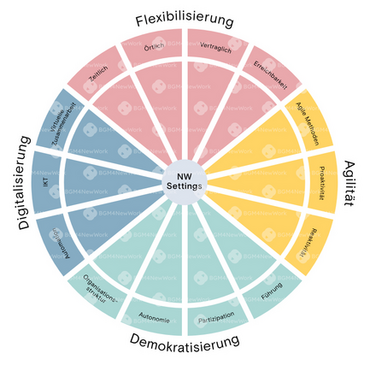
Figure 1 visualises the multidimensional working definition of NW settings based on the four areas of agility, democratisation, digitalisation and flexibilisation. We have distinguished between the four areas based on the literature and a selection of individual definitions. These areas can be further differentiated into various facets. We would like to point out that there may be overlaps between facets and areas when considering different definitions. For the schematic representation of our working definition of NW settings (Figure 1), we use spider diagrams. Each facet can vary in its expression on a continuum.
Source (text and image): Institute for Occupational, Social and Preventive Medicine, Charité – Universitätsmedizin Berlin
Drivers and consequences of new work settings
Using the multidimensional working definition of NW settings, the next step is to develop an online questionnaire to examine different characteristics of these forms of work. Transformation processes in the world of work are being accelerated by various catalysts and drivers. These influencing factors, such as demographic change, digitalisation, globalisation, the COVID-19 pandemic, the market situation, climate change and changing values, are operationalised as contextual factors in the project.
In addition, various topics that are (or could be) related to NW settings are considered. Outcome variables have been defined as aspects that describe the experience of employees and the perceived consequences of working in NW settings. These include, for example, various health parameters, job satisfaction and work-life balance. In addition, there are individual factors that (could) have a (moderating or mediating) influence on the effect of NW settings on outcome variables (see Figure 2). In this area, we will examine, for example, psychological empowerment [4, 5] and various individual competencies.

Learning system
If there is one characteristic that defines the modern world of work, it is change. New technologies are transforming everyday working life at a pace that was previously unimaginable. At the current forefront of this development have been large language models and chatbots such as ChatGPT. In order to keep pace with these changes, the BGM4NW project has been expanded. As part of the project, an artifically intelligent-supported tool is now being developed that will provide precise feedback to employees. After a brief input, employees will receive:
- Feedback on their individual working conditions
- An individualised competence profile
- Suggestions as to which occupational health management measures would be best suited to promoting their health
The tool is being developed in collaboration with the Technical University of Berlin and will be presented at the end of the project.
References
[1] Schermuly, C. (Gast). (2022, 04. Mai). New Work Utopia: Eine bessere Arbeitswelt ohne Angst und Panikmache! Prof. Carsten Schermuly – Wissenschaftler [Audio-Podcast]. In Arbeitsphilosophen – Die Zukunft der Arbeit. open.spotify.com/episode/2zvHAAg6u814UP30T3xkWb
[2] Bergmann, F., & Schumacher, S. (2005). Neue Arbeit, neue Kultur. arbor.
[3] Schermuly, C. C. (2019). New Work und Coaching – psychologisches Empowerment als Chance für Coaches. Organisationsberatung, Supervision, Coaching, 26(2), 173-192.
[4] Spreitzer, G.M. (1995). Psychological empowerment in the workplace: Dimensions, measurement, and validation. Academy of Management Journal, 38(5), 1442–1465. doi.org/10.2307/256865.
[5] Schermuly, C. C., & Koch, J. (2019). New Work und psychische Gesundheit. In Fehlzeiten-Report 2019 (pp. 127-139).
Publication
Occupational Health Management in NewWork - a Protocol for a Mixed - Method Study: Projekt BGM4NewWork (Posted Septemer 22, 2023)
Contact
Project management
contact information
- e-mail address: susanne.voelter-mahlknecht(at)med.uni-goettingen.de
- Fachärztin für Arbeitsmedizin
- Fachärztin für Haut- und Geschlechtskrankheiten
- Mitglied des Ausschusses für Arbeitsmedizin (AfAMed) des Bundesministeriums für Arbeit und Soziales (BMAS)
- Weiterbildungsermächtigung für den Facharzt "Arbeitsmedizin" (Ärztekammer Berlin)
- Mitglied der Sachverständigenkommissionen beim Institut für Medizinische und Pharmazeutische Prüfungsfragen (IMPP)
- Vorstandsmitglied der Fachgesellschaft DGAUM (Deutschen Gesellschaft für Arbeits- und Umweltmedizin)
- Mitglied des AG "Zukunft der Arbeit nach Corona" der Leopoldina - Working Group "future of work"
- Mitglied des Ehrenrats der DGAUM