New Work - New Health! Rethinking and reshaping health
Department of Occupational, Social and Preventive Medicine
Trough demographic, economic and social change, digitalisation and the use of new technologies, change processes in the world of work are becomming increasingly important (e.g. generational change, skill shortages, changing requirements in working environments, use of new technologies).
New Work describes a monumental change that begins in the world of work and fundamentally transforms our lives. The coronavirus pandemic has proven to be a catalyst for New Work. The need to consider health in transformation processes is more pressing than ever.
What does (healthy) work look like in a digital, flexible and agile future?
The research focus on New Work – New Health of the Department of Occupational Medicine takes a holistic view of health of these developments. It focuses on practice-oriented research projects with a participatory approach and human-centred design.
Our research priorities include digitalisation, new technologies (AI, IoT, VR), digital workplaces, flexibility, working from home, work-life blending, agility, organisational culture, demographic change, Work 4.0, telework, diversity, participation, employee health experience and empowerment.
Ongoing projects
BGM4NewWork GesundAgil B.eJustice
Multidimensional working definition of New Work settings
As part of the BGM4NewWork project at the Institute for Occupational, Social and Preventive Medicine at Charité – Universitätsmedizin Berlin, a multidimensional working definition for New Work settings was developed. New Work is increasingly the focus of scientific and social discourse. The however, led to Work appears becomming somewhat of a ‘container term’ [1]. Different aspects, such as working from home or agile project work, are part of New Work, and people often ‘help themselves’ to various elements of this container term according to their own wishes and define these elements arbitrarily as New Work. However, there is currently no comprehensive and uniform definition of New Work. Based on Frithjof Bergmann's original philosophical construct, it becomes clear that New Work is more than just one individual New Work measure or New Work setting [2, 3]. New forms of work should aim to holistically promote the resources of employees rather than exhausting them [2].
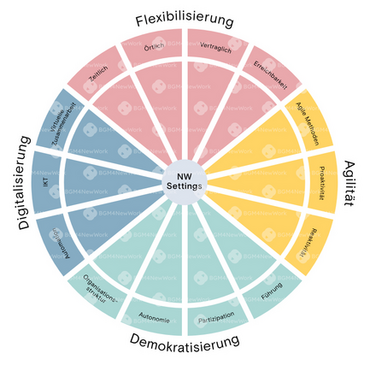
As a first step, it can be helpful to focus on New Work settings (NW settings) – i.e. the specific forms of work involved in New Work and the framework conditions of one's own work. Figure 1 visualises our multidimensional working definition of NW settings based on four areas: agility, democratisation, digitalisation and flexibilisation. These areas can be further differentiated by different facets. These four areas were chosen on a basis of literature research, expert workshops and selections of individual definitions. We would like to point out that there may be overlaps between facets and areas when considering different definitions in the literature. Furthermore, both the areas and facets are not set in stone, and the model can adapted or expanded for a needs-based approach and future collaboration with companies. For the schematic representation of our working definition of NW settings (Figure 1), we use spider diagrams as a guide. Each facet can vary in its expression on a continuum. Based on this working definition, a questionnaire is being developed.
Source of figure and text: Institute for Occupational, Social and Preventive Medicine, Charité – Universitätsmedizin Berlin (2022, November). Working definition for new work settings.
Referenzen
[1] Schermuly, C. (Gast). (2022, 04. Mai). New Work Utopia: Eine bessere Arbeitswelt ohne Angst und Panikmache! Prof. Carsten Schermuly – Wissenschaftler [Audio-Podcast]. In Arbeitsphilosophen – Die Zukunft der Arbeit. open.spotify.com/episode/2zvHAAg6u814UP30T3xkWb
[2] Bergmann, F., & Schumacher, S. (2005). Neue Arbeit, neue Kultur. arbor.
[3] Schermuly, C. C. (2019). New Work und Coaching – psychologisches Empowerment als Chance für Coaches. Organisationsberatung, Supervision, Coaching, 26(2), 173-192.